Term
sheet
To prospectus dated November 14, 2011,
prospectus supplement dated November 14, 2011 and
product supplement no. 2-I dated November 14, 2011 |
Term
Sheet to
Product Supplement No. 2-I
Registration Statement No. 333-177923
Dated December 21, 2011; Rule 433 |

Structured
Investments |
|
$
Range Accrual
Notes Linked to the S&P GSCITM Brent Crude Oil Index Excess Return due |
General
| · | | The notes are designed for investors who seek contingent interest payments linked
to the Index, while seeking the return of at least 95% of their principal at maturity. For each interest payment period, interest
will accrue at the applicable Interest Factor only on calendar days with respect to which the Index Closing Level as of the applicable
Accrual Determination Date is greater than or equal to and less than or equal to . Any payment on the notes is subject
to the credit risk of JPMorgan Chase & Co. |
| · | | Senior unsecured obligations of JPMorgan Chase & Co. maturing , subject to postponement
as described below |
| · | | Minimum denominations of $1,000 and integral multiples thereof |
| · | | The notes are expected to price on or about December , 2011 and are expected to settle
on or about December , 2011. |
| · | | The notes are not commodity futures contracts and are not regulated under the Commodity
Exchange Act of 1936, as amended (the “Commodity Exchange Act”). The notes are offered pursuant to an exemption
from regulation under the Commodity Exchange Act, commonly known as the hybrid instrument exemption, that is available to securities
that have one or more payments indexed to the value, level or rate of one or more commodities, as set out in section 2(f) of that
statute. Accordingly, you are not afforded any protection provided by the Commodity Exchange Act or any regulation promulgated
by the Commodity Futures Trading Commission. |
Key Terms
| Index |
The S&P GSCITM Brent Crude Oil Index Excess Return (the “Index”). The value of the S&P GSCITM Brent Crude Oil Index Excess Return is published each trading day under the Bloomberg ticker symbol “SPGCBRP.” For more information on the Index, please see “Selected Purchase Considerations — Return Linked to the S&P GSCITM Brent Crude Oil Index Excess Return” in this term sheet. |
| Maturity Date*: |
|
| Payment at Maturity: |
At maturity you will receive a cash payment for each $1,000 principal amount note of $950 plus any accrued and unpaid interest. |
| Interest: |
With respect to each Interest Payment Period, for each $1,000
principal amount note, the interest payment will be calculated as follows:
$1,000 × Interest Rate × (number
of days in the Interest Payment Period / 360),
where the number of days in the Interest Payment Period will
be calculated on the basis of a year of 360 days with twelve months of thirty days each. |
| Interest Rate: |
With respect to each Interest Payment Period, a rate per annum, calculated as follows: |
| |
Interest Factor × |
Variable Days
Actual Days |
, where |
| |
“Variable Days” is the actual number of calendar
days during that Interest Payment Period on which the Accrual Provision is satisfied, and “Actual Days” means, with
respect to each Interest Payment Date, the actual number of calendar days in the Interest Payment Period.
The Interest Rate may not equal the Interest Factor during
any Interest Payment Period. The Interest Rate will depend on the number of calendar days during any given Interest Payment Period
on which the Accrual Provision is satisfied and may be zero. |
| Interest Factor: |
% per annum |
| Interest Payment Period: |
The period beginning on and including the issue date of the notes and ending on but excluding the first Interest Payment Date and each successive period beginning on and including an Interest Payment Date and ending on but excluding the next succeeding Interest Payment Date |
| Other Key Terms: |
Please see “Additional Key Terms” in this term sheet for other key terms. |
* Subject to postponement in the event of a
market disruption event and as described under “Description of Notes — Payment at Maturity,” “Description
of Notes — Interest Payments” and “Description of Notes — Postponement of a Determination Date —
Single Component Notes Linked to a Single Index” in the accompanying product supplement no. 2-I or early acceleration in
the event of a commodity hedging disruption event as described under “General Terms of Notes — Consequences of a Commodity
Hedging Disruption Event — Early Acceleration of Payment on the Notes” in the accompanying product supplement no. 2-I
and in “Selected Risk Considerations — We May Accelerate Your Notes If a Commodity Hedging Disruption Event Occurs”
in this term sheet.
Investing in the Range Accrual Notes involves
a number of risks. See “Risk Factors” beginning on page PS-16 of the accompanying product supplement no. 2-I and “Selected
Risk Considerations” beginning on page TS-3 of this term sheet.
Neither the Securities and Exchange Commission
nor any state securities commission has approved or disapproved of the notes or passed upon the accuracy or the adequacy of this
term sheet or the accompanying prospectus supplement and prospectus. Any representation to the contrary is a criminal offense.
| |
Price to Public |
Fees and Commissions (1) |
Proceeds to Us |
| Per note |
$ |
$ |
$ |
| Total |
$ |
$ |
$ |
| (1) | | The price to the public includes the estimated cost of hedging our obligations under
the notes through one or more of our affiliates. |
| (2) | | If the notes priced today, J.P. Morgan Securities LLC, which we refer to as JPMS,
acting as agent for JPMorgan Chase & Co., would receive a commission of approximately $ per $1,000 principal amount note.
This commission includes the projected profits that our affiliates expect to realize, some of which may be allowed to other unaffiliated
dealers, for assuming risks inherent in hedging our obligations under the notes. The actual commission received by JPMS may be
more or less than $ and will depend on market conditions on the pricing date. In no event will the commission received by JPMS
exceed $ per $1,000 principal amount note. See “Plan of Distribution (Conflicts of Interest)” beginning on page PS-89
of the accompanying product supplement no. 2-I. |
The notes are not bank deposits and are
not insured by the Federal Deposit Insurance Corporation or any other governmental agency, nor are they obligations of, or guaranteed
by, a bank.
December 21, 2011
Additional Terms Specific
to the Notes
JPMorgan Chase & Co. has filed a registration
statement (including a prospectus) with the Securities and Exchange Commission, or SEC, for the offering to which this term sheet
relates. Before you invest, you should read the prospectus in that registration statement and the other documents relating to this
offering that JPMorgan Chase & Co. has filed with the SEC for more complete information about JPMorgan Chase & Co. and
this offering. You may get these documents without cost by visiting EDGAR on the SEC website at www.sec.gov. Alternatively, JPMorgan
Chase & Co., any agent or any dealer participating in this offering will arrange to send you the prospectus, the prospectus
supplement, product supplement no. 2-I and this term sheet if you so request by calling toll-free 866-535-9248.
You may revoke your offer to purchase
the notes at any time prior to the time at which we accept such offer by notifying the applicable agent. We reserve the right to
withdraw, cancel or modify this offering and to reject orders in whole or in part. In the event of any changes to the terms of
the notes, we will notify you and you will be asked to accept such changes in connection with your purchase. You may also choose
to reject such changes in which case we may reject your offer to purchase.
You should read this term sheet together
with the prospectus dated November 14, 2011, as supplemented by the prospectus supplement dated November 14, 2011 relating to our
Series E medium-term notes of which these notes are a part, and the more detailed information contained in product supplement no.
2-I dated November 14, 2011. This term sheet, together with the documents listed below, contains the terms of the notes and
supersedes all other prior or contemporaneous oral statements as well as any other written materials including preliminary or indicative
pricing terms, correspondence, trade ideas, structures for implementation, sample structures, fact sheets, brochures or other educational
materials of ours. You should carefully consider, among other things, the matters set forth in “Risk Factors” in
the accompanying product supplement no. 2-I, as the notes involve risks not associated with conventional debt securities. We urge
you to consult your investment, legal, tax, accounting and other advisers before you invest in the notes.
You may access these documents on the SEC website
at www.sec.gov as follows (or if such address has changed,
by reviewing our filings for the relevant date on the SEC website):
Our Central Index Key, or CIK, on the SEC website
is 19617. As used in this term sheet, the “Company,” “we,” “us” and “our” refer
to JPMorgan Chase & Co.
Additional Key Terms
| Interest Payment Dates*: |
Interest, if any, on the notes will be payable quarterly in arrears on the calendar day of , , and of each year, up to and including the final quarterly interest payment, which will be payable on the Maturity Date (each such date, an “Interest Payment Date”), commencing , 2012 See “Selected Purchase Considerations — Contingent Quarterly Interest Payments” in this term sheet for more information. |
| Accrual Provision: |
For each Interest Payment Period, the Accrual Provision shall be deemed to have been satisfied on each calendar day during such Interest Payment Period on which the Index Closing Level, as determined on the Accrual Determination Date relating to such calendar day, is within the Index Range. If the Index Closing Level determined on any Accrual Determination Date relating to a calendar day is not within the Index Closing Level Range, then the Accrual Provision shall be deemed not to have been satisfied for such calendar day. |
| Index Range: |
Greater than or equal to and less than or equal to |
| Index Strike Level: |
An Index level to be determined on the pricing date in the sole discretion of the Note Calculation Agent. The Index Strike Level may or may not be the regular official weekday closing level of the Index on the pricing date. Although the Note Calculation Agent will make all determinations and will take all actions in relation to the establishment of the Index Strike Level in good faith, it should be noted that such discretion could have an impact (positive or negative) on the value of your notes. The Note Calculation Agent is under no obligation to consider your interests as a holder of the notes in taking any actions, including the determination of the Index Strike Level, that might affect the value of your notes. |
| Accrual Determination Date*: |
For each calendar day during an Interest Payment Period, the second trading day prior to such calendar day. Notwithstanding the foregoing, for all calendar days in the Exclusion Period, the Accrual Determination Date will be the first trading day that precedes such Exclusion Period. |
| Exclusion Period: |
The period commencing on the seventh business day prior to but excluding each Interest Payment Date. |
| CUSIP: |
|
Supplemental Terms of the
Notes
For purposes of the notes offered by this term
sheet:
(1) the consequences of a commodity hedging
disruption event are described under “General Terms of Notes — Consequences of a Commodity Hedging Disruption Event
— Early Acceleration of Payment on the Notes” in the accompanying product supplement no. 2-I;
(2) each Accrual Determination Date is a “Determination
Date” as described in the accompanying product supplement no. 2-I and is subject to postponement as described under “Description
of Notes — Postponement of a Determination Date — Single Component Notes Linked to a Single Index” in the accompanying
product supplement no. 2-I; and
JPMorgan Structured Investments —
|
TS-2 |
| Range
Accrual Notes linked to the S&P GSCI™ Brent Crude Oil Index Excess Return |
(3) the fourth paragraph under “General
Terms of Notes — Payment upon an Event of Default” in the accompanying product supplement no. 2-I is deemed deleted
and replaced in its entirety by the following:
“Upon any acceleration of the notes,
any interest will be calculated on the basis of a 360-day year of twelve 30-day months and the actual number of days elapsed from
and including the previous Interest Payment Date for which interest was paid.”
Selected Purchase Considerations
| · | | POTENTIAL PRESERVATION OF 95% OF YOUR PRINCIPAL AT MATURITY — Subject
to the credit risk of JPMorgan Chase & Co., the payout formula allows you to receive at least 95% of your initial investment
if you hold the notes to maturity, regardless of whether the Accrual Provision is satisfied for any calendar day of any Interest
Payment Period. Because the notes are our senior unsecured obligations, payment of any amount on the notes is subject to our ability
to pay our obligations as they become due. |
| · | | CONTINGENT QUARTERLY INTEREST PAYMENTS
— The notes offer quarterly interest payments at the applicable Interest Rate. Interest will accrue at a rate
per annum equal to the product of (1) the Interest Factor and (2) the Variable Days divided by the Actual Days. Interest,
if any, will be payable quarterly in arrears on the calendar day of , , and of each year, up to and including the final quarterly
interest payment, which will be payable on the Maturity Date (each such date, an “Interest Payment Date”), commencing
, 2012. Interest will be payable to the holders of record at the close of business on the business day immediately preceding the
applicable Interest Payment Date. If an Interest Payment Date is not a business day, payment will be
made on the next business day immediately following such day, but no additional interest will accrue as a result of the delayed
payment. |
| · | | RETURN LINKED TO THE S&P GSCI™
Brent Crude Oil Index Excess Return — The return on the notes is linked solely to the S&P GSCI™ Brent
Crude Oil Index Excess Return, a sub-index of the S&P GSCI™, a composite index of commodity sector returns, calculated,
maintained and published daily by Standard & Poor Financial Services LLC. The S&P GSCI™ is a world production-weighted
index that is designed to reflect the relative significance of principal non-financial commodities (i.e., physical commodities)
in the world economy. The S&P GSCI™ represents the return of a portfolio of the futures contracts for the underlying
commodities. The S&P GSCI™ Brent Crude Oil Index Excess Return references the front-month Brent crude oil futures contract
(i.e., the Brent crude futures contract generally closest to expiration) traded on ICE Futures Europe. The S&P GSCI™
Brent Crude Oil Index Excess Return provides investors with a publicly available benchmark for investment performance in the Brent
crude oil commodity markets. The S&P GSCI™ Brent Crude Oil Index Excess Return is an excess return index and not a total
return index. An excess return index reflects the returns that are potentially available through an unleveraged investment in
the contracts composing the index (which, in the case of the Index, are the designated crude oil futures contracts). By contrast,
a “total return” index, in addition to reflecting those returns, also reflects interest that could be earned on funds
committed to the trading of the underlying futures contracts. See “The S&P GSCI Indices” in the accompanying product
supplement no. 2-I. |
Selected Risk Considerations
An investment in the notes involves significant
risks. Investing in the notes is not equivalent to investing directly in the Index, any futures contracts underlying the Index
or any related commodities. These risks are explained in more detail in the “Risk Factors” section of the accompanying
product supplement no. 2-I dated November 14, 2011.
| · | | THE NOTES MAY NOT PAY MORE THAN 95% OF THE PRINCIPAL AMOUNT AT MATURITY
— If the Accrual Provision is not satisfied on any calendar day during the Interest Payment Period preceding
the Maturity Date, we will pay you only 95% of the principal amount of your notes at maturity, subject to the credit risk of JPMorgan
Chase & Co. |
| · | | THE NOTES ARE NOT ORDINARY DEBT SECURITIES;
THE INTEREST RATE ON THE NOTES IS NOT FIXED BUT IS VARIABLE
— The rate of interest paid by us on the notes for each Interest Payment Period is not fixed, but will vary depending
on whether the Accrual Provision is satisfied, and whether such Accrual Provision is satisfied will depend on the daily fluctuations
of the Index Closing Level. Consequently, the return on the notes may be less than those otherwise payable on debt issued by us
with similar maturities. You should consider, among other things, the overall annual percentage rate of interest to maturity as
compared to other equivalent investment alternatives. |
| · | | THE INTEREST RATE ON THE NOTES IS LIMITED BY THE INTEREST FACTOR —The
Interest Rate for each Interest Payment Period will be limited by the Interest Factor. Interest will accrue at a rate per annum
equal to the product of (1) the Interest Factor and (2) the Variable Days divided by the Actual Days. As a result, the
Interest Rate for any Interest Payment Period will never exceed the applicable Interest Factor. |
| · | | THE INTEREST RATE ON THE NOTES IS BASED ON AN ACCRUAL PROVISION LINKED TO THE INDEX,
WHICH MAY RESULT IN AN INTEREST RATE OF ZERO — Although the maximum rate is equal to the Interest Factor of % per annum,
for every calendar day during any Interest Payment Period on which the Accrual Provision is not satisfied, the Interest Rate for
that Interest Payment Period will be reduced. We cannot predict the factors that may cause the Accrual Provision to be satisfied,
or not, on any calendar day. The amount of interest you accrue on the notes in any Interest Payment Period may not increase even
if the Index Closing Level increases. If the Accrual Provision is not satisfied for an entire Interest Payment Period, the Interest
Rate for such period would be zero. In that event, you will not be compensated for any loss in value
due to inflation and other factors relating to the value of money over time during such period. |
JPMorgan Structured Investments —
|
TS-3 |
| Range
Accrual Notes linked to the S&P GSCI™ Brent Crude Oil Index Excess Return |
| · | | CREDIT RISK OF JPMORGAN CHASE & CO. — The notes are subject to the
credit risk of JPMorgan Chase & Co. and our credit ratings and credit spreads may adversely affect the market value of the
notes. Investors are dependent on JPMorgan Chase & Co.’s ability to pay all amounts due on the notes, and therefore
investors are subject to our credit risk and to changes in the market’s view of our creditworthiness. Any decline in our
credit ratings or increase in the credit spreads charged by the market for taking our credit risk is likely to affect adversely
the value of the notes. If we were to default on our payment obligations, you may not receive any amounts owed to you under the
notes and you could lose your entire investment |
| · | | POTENTIAL CONFLICTS — We and our affiliates play a variety of roles in
connection with the issuance of the notes, including acting as Note Calculation Agent and hedging our obligations under the notes.
In performing these duties, the economic interests of the Note Calculation Agent and other affiliates of ours are potentially
adverse to your interests as an investor in the notes. It is possible that these hedging or trading activities of ours or our
affiliates could result in substantial returns for us or our affiliates while the value of the notes declines. The
Index Strike Level will be an Index level determined on the pricing date in the sole discretion of the Note Calculation Agent.
Although the Note Calculation Agent will make all determinations and will take all actions in relation to the establishment of
the Index Strike Level in good faith, it should be noted that such discretion could have an impact (positive or negative) on the
value of your notes. The Note Calculation Agent is under no obligation to consider your interests as a holder of the notes in
taking any actions, including the determination of the Index Strike Level, that might affect the value of your notes. |
| · | | WE MAY ACCELERATE YOUR NOTES IF A COMMODITY HEDGING DISRUPTION EVENT OCCURS —
If we or our affiliates are unable to effect transactions necessary to hedge our obligations under the notes due to a commodity
hedging disruption event, we may, in our sole and absolute discretion, accelerate the payment on your notes and pay you an amount
determined in good faith and in a commercially reasonable manner by the Note Calculation Agent. If the payment on your notes is
accelerated, your investment may result in a loss and you may not be able to reinvest your money in a comparable investment. Please
see “General Terms of Notes — Consequences of a Commodity Hedging Disruption Event — Early Acceleration of Payment
on the Notes” in the accompanying product supplement no. 2-I for more information. |
| · | | COMMODITY FUTURES CONTRACTS ARE SUBJECT TO UNCERTAIN LEGAL AND REGULATORY REGIMES
— The commodity futures contracts that underlie the Index are subject to legal and regulatory regimes in the United
States and, in some cases, in other countries that may change in ways that could adversely affect our ability to hedge our obligations
under the notes and affect the value of the Index. Any future regulatory changes, including but not limited to changes resulting
from the Dodd-Frank Wall Street Reform and Consumer Protection Act (the “Dodd-Frank Act”), which was enacted on July
21, 2010, may have a substantial adverse effect on the value of your notes. Additionally, in accordance with the Dodd-Frank Act,
the U.S. Commodity Futures Trading Commission has adopted regulations that establish position limits for certain commodity-based
futures contracts, such as futures contracts on certain energy, agricultural and metals based commodities. These regulations may
reduce liquidity in the exchange-traded market for such commodity-based futures contracts. Furthermore, we or our affiliates may
be unable as a result of such restrictions to effect transactions necessary to hedge our obligations under the notes, in which
case we may, in our sole and absolute discretion, accelerate the payment on your notes. See “We May Accelerate Your Notes
If a Commodity Hedging Disruption Event Occurs” above. |
| · | | PRICES OF COMMODITY FUTURES CONTRACTS ARE CHARACTERIZED BY HIGH AND UNPREDICTABLE
VOLATILITY, WHICH COULD LEAD TO HIGH AND UNPREDICTABLE VOLATILITY IN THE INDEX — Market prices of the commodity futures
contracts included in the Index tend to be highly volatile and may fluctuate rapidly based on numerous factors, including the
factors that affect the price of the commodities underlying the commodity futures contracts included in the Index. See “There
Are Risks Associated With an Investment Linked Indirectly to Crude Oil” below. The prices of commodities and commodity futures
contracts are subject to variables that may be less significant to the values of traditional securities, such as stocks and bonds.
These variables may create additional investment risks that cause the value of the notes to be more volatile than the values of
traditional securities. As a general matter, the risk of low liquidity or volatile pricing around the maturity date of a commodity
futures contract is greater than in the case of other futures contracts because (among other factors) a number of market participants
take physical delivery of the underlying commodities. Many commodities are also highly cyclical. The high volatility and cyclical
nature of commodity markets may render such an investment inappropriate as the focus of an investment portfolio. |
| · | | THERE ARE RISKS ASSOCIATED WITH AN INVESTMENT LINKED INDIRECTLY TO CRUDE OIL
— Global prices of energy commodities, including crude oil, are primarily affected by the global demand for and supply of
these commodities, but are also significantly influenced by speculative actions and by currency exchange rates. In addition, prices
for energy commodities are affected by governmental programs and policies, national and international political and economic events,
changes in interest and exchange rates, trading activities in commodities and related contracts, trade, fiscal, monetary and exchange
control policies and with respect to oil, drought, floods, weather, government intervention, environmental policies, embargoes
and tariffs. Demand for refined petroleum products by consumers, as well as the agricultural, manufacturing and transportation
industries, affects the price of energy commodities. Sudden disruptions in the supplies of energy commodities, such as those caused
by war, natural events, accidents or acts of terrorism, may cause prices of energy commodities futures contracts to become extremely
volatile and unpredictable. Also, sudden and dramatic changes in the futures market may occur, for example, upon a cessation of
hostilities that may exist in countries producing energy commodities, the introduction of new or previously withheld supplies
into the market or the introduction
of substitute products or commodities. In particular, supplies of crude oil may increase or decrease depending on, among other
factors, production decisions by the Organization of |
JPMorgan Structured Investments —
|
TS-4 |
| Range
Accrual Notes linked to the S&P GSCI™ Brent Crude Oil Index Excess Return |
the Oil and Petroleum Exporting Countries (“OPEC”) and other
crude oil producers. Crude oil prices are determined with significant influence by OPEC, which has the capacity to influence oil
prices worldwide because its members possess a significant portion of the world’s oil supply. Crude oil prices are generally
more volatile and subject to dislocation than prices of other commodities. Demand for energy commodities such as oil and gasoline
is generally linked to economic activity, and will tend to reflect general economic conditions.
| · | | FUTURES CONTRACTS ON BRENT CRUDE OIL ARE THE BENCHMARK CRUDE OIL CONTRACTS IN EUROPEAN
AND ASIAN MARKETS — Because futures contracts on Brent crude oil are the benchmark crude oil contracts in European and
Asian markets, the Brent crude oil futures contracts included in the Index will be affected by economic conditions in Europe and
Asia. A decline in economic activity in Europe or Asia could result in decreased demand for crude oil and for futures contracts
on crude oil, which could adversely affect the value of the Brent crude oil futures contracts included in the Index and, therefore,
the Index and the notes. |
| · | | A DECISION BY AN EXCHANGE ON WHICH THE FUTURES CONTRACTS UNDERLYING THE INDEX ARE
TRADED TO INCREASE MARGIN REQUIREMENTS MAY AFFECT THE LEVEL OF THE INDEX — If an exchange on which the futures contract
underlying the Index are traded increases the amount of collateral required to be posted to hold positions in such futures contracts
(i.e., the margin requirements), market participants who are unwilling or unable to post additional collateral may liquidate
their positions, which may cause the level of the Index to decline significantly. |
| · | | THE INDEX MAY BE MORE VOLATILE AND SUSCEPTIBLE TO PRICE FLUCTUATIONS OF COMMODITY
FUTURES CONTRACTS THAN A BROADER COMMODITIES INDEX — The Index may be more volatile and susceptible to price fluctuations
than a broader commodities index, such as the S&P GSCI™. In contrast to the S&P GSCI™, which includes contracts
on crude oil and non-crude oil commodities, the Index comprises contracts on only crude oil. As a result, price volatility in
the contracts included in the Index will likely have a greater impact on the Index than it would on the broader S&P GSCI™.
In addition, because the Index omits principal market sectors composing the S&P GSCI™, it will be less representative
of the economy and commodity markets as a whole and will therefore not serve as a reliable benchmark for commodity market performance
generally. |
| · | | THE NOTES DO NOT OFFER DIRECT EXPOSURE TO COMMODITY SPOT PRICES — The
notes are linked to the Index, which tracks commodity futures contracts, not physical commodities (or their spot prices). The
price of a futures contract reflects the expected value of the commodity upon delivery in the future, whereas the spot price of
a commodity reflects the immediate delivery value of the commodity. A variety of factors can lead to a disparity between the expected
future price of a commodity and the spot price at a given point in time, such as the cost of storing the commodity for the term
of the futures contract, interest charges incurred to finance the purchase of the commodity and expectations concerning supply
and demand for the commodity. The price movements of a futures contract are typically correlated with the movements of the spot
price of the referenced commodity, but the correlation is generally imperfect and price movements in the spot market may not be
reflected in the futures market (and vice versa). Accordingly, the notes may underperform a similar investment that is linked
to commodity spot prices. |
| · | | OWNING THE NOTES IS NOT THE SAME AS OWNING ANY COMMODITIES OR COMMODITY FUTURES
CONTRACTS — The return on your notes will not reflect the return you would realize if you actually purchased the futures
contracts composing the Index, the commodities upon which the futures contracts that compose the Index are based, or other exchange-traded
or over-the-counter instruments based on the Index. You will not have any rights that holders of such assets or instruments have. |
| · | | HIGHER FUTURES PRICES OF THE COMMODITY FUTURES CONTRACTS UNDERLYING THE INDEX RELATIVE
TO THE CURRENT PRICES OF SUCH CONTRACTS MAY AFFECT THE VALUE OF THE INDEX AND THE VALUE OF THE NOTES — The Index is
composed of futures contracts on physical commodities. Unlike equities, which typically entitle the holder to a continuing stake
in a corporation, commodity futures contracts normally specify a certain date for delivery of the underlying physical commodity.
As the exchange-traded futures contracts that compose the Index approach expiration, they are replaced by contracts that have
a later expiration. Thus, for example, a contract purchased and held in August may specify an October expiration. As time passes,
the contract expiring in October is replaced with a contract for delivery in November. This process is referred to as “rolling.”
If the market for these contracts is (putting aside other considerations) in “contango,” where the prices are higher
in the distant delivery months than in the nearer delivery months, the purchase of the November contract would take place at a
price that is higher than the price of the October contract, thereby creating a negative “roll yield.” Contango
could adversely affect the value of the Index and thus the value of notes linked to the Index. The futures contracts underlying
the Index have historically been in contango. |
| · | | SUSPENSION OR DISRUPTIONS OF MARKET TRADING IN THE COMMODITY MARKETS AND RELATED
FUTURES MARKETS MAY ADVERSELY AFFECT THE LEVEL OF THE INDEX, AND THEREFORE THE VALUE OF THE NOTES — The commodity markets
are subject to temporary distortions or other disruptions due to various factors, including the lack of liquidity in the markets,
the participation of speculators and government regulation and intervention. In addition, U.S. futures exchanges and some foreign
exchanges have regulations that limit the amount of fluctuation in futures contract prices that may occur during a single day.
These limits are generally referred to as “daily price fluctuation limits” and the maximum or minimum price of a contract
on any given day as a result of these limits is referred to as a “limit price.” Once the limit price has been reached
in a particular contract, no trades may be made at a different price. Limit prices have the effect of precluding trading in a
particular contract or forcing the liquidation of contracts at disadvantageous times or prices. These circumstances could adversely
affect the level of the Index and, therefore, the value of your notes. |
JPMorgan Structured Investments —
|
TS-5 |
| Range
Accrual Notes linked to the S&P GSCI™ Brent Crude Oil Index Excess Return |
| · | | CERTAIN BUILT-IN COSTS ARE LIKELY TO AFFECT ADVERSELY THE VALUE OF THE NOTES PRIOR
TO MATURITY — While the payment at maturity described
in this term sheet is based on 95% of the principal amount of your notes, the original issue price of the notes includes the agent’s
commission and the estimated cost of hedging our obligations under the notes. As a result, and as a general matter, the price,
if any, at which JPMS will be willing to purchase notes from you in secondary market transactions, if at all, will likely be lower
than the original issue price, and any sale prior to the Maturity Date could result in a substantial loss to you. This secondary
market price will also be affected by a number of factors aside from the agent’s commission and hedging costs, including
those set forth under “Many Economic and Market Factors Will Impact the Value of the Notes” below. |
The notes are not
designed to be short-term trading instruments. Accordingly, you should be able and willing to hold your notes to maturity.
| · | | The notes are linked to an excess return
index and not a total return index — The notes are linked to an excess return index and not a total return index.
An excess return index, such as the Index, reflects the returns that are potentially available through an unleveraged investment
in the contracts composing such index. By contrast, a “total return” index, in addition to reflecting those returns,
also reflects interest that could be earned on funds committed to the trading of the underlying futures contracts. |
| · | | WHETHER THE Accrual PROVISION IS SATISFIED
WILL DEPEND ON A NUMBER OF FACTORS, WHICH MAY RESULT IN AN INTEREST RATE OF ZERO — The amount of interest, if
any, payable on the notes will depend on a number of factors that can affect the Index including, but not limited to: |
| · | | changes in, or perceptions about, future Index Closing Levels; |
| · | | general economic conditions; and |
| · | | the factors described below under “— Many Economic and Market Factors
will Impact the Value of the Notes.” |
These and other factors
may have a negative impact on the payment of interest on the notes. In addition, these and other factors may have a negative impact
on the value of your notes in the secondary market.
| · | | the method of determining the interest
rate for any Interest PAYMENT Period may not directly correlate with THE INDEX — The determination of the Interest
Rate payable for any Interest Payment Period will be based, in part, on the Index, but it will not directly correlate with the
Index. We will use the Index Closing Level on each Accrual Determination Date to determine whether the Accrual Provision is satisfied
for any calendar day in the applicable Interest Payment Period. |
| · | | LACK OF LIQUIDITY —
The notes will not be listed on any securities exchange. JPMS intends to offer to purchase the notes in the secondary market but
is not required to do so. Even if there is a secondary market, it may not provide enough liquidity to allow you to trade or sell
the notes easily. Because other dealers are not likely to make a secondary market for the notes, the price at which you may be
able to trade your notes is likely to depend on the price, if any, at which JPMS is willing to buy the notes. |
| · | | MANY ECONOMIC AND MARKET FACTORS WILL IMPACT THE VALUE OF THE NOTES
— In addition to the level of the Index on any day of an Interest Payment Period, the value of the notes will
be affected by a number of economic and market factors that may either offset or magnify each other, including: |
| · | | the volatility, frequency and magnitude of changes in the Index; |
| · | | the time to maturity of the notes; |
| · | | interest and yield rates in the market generally; |
| · | | a variety of economic, financial, political, regulatory, geographical, agricultural,
meteorological and judicial events; and |
| · | | our creditworthiness, including actual or anticipated downgrades in our credit ratings. |
JPMorgan Structured Investments —
|
TS-6 |
| Range
Accrual Notes linked to the S&P GSCI™ Brent Crude Oil Index Excess Return |
Hypothetical Examples of
Calculation of the Interest Rate on the Notes for an Interest Payment Period
The following examples illustrate how to
calculate the Interest Rate on the notes for three hypothetical Interest Payment Periods. For purposes of the following examples,
we have assumed that there are 90 days in the applicable Interest Payment Period and that the Interest Factor is 10% per annum.
The actual Interest Factor will be determined on the Pricing Date and may be less than 10% per annum. If the actual Interest
Factor as determined on the Pricing Date is less than 10% per annum, your interest payment, if any, on any Interest Payment Date
may be less than the amounts shown below. The hypothetical Index Closing Levels and Interest Rates in the following examples are
for illustrative purposes only and may not correspond to the actual Index Strike Level or Interest Rates for any Interest Payment
Period applicable to a purchaser of the notes. The numbers appearing in the following examples have been rounded for ease of analysis.
Example
1: The Index Closing Level is within the Index Range on 70 calendar days during the Interest Payment Period. Because
the Accrual Provision is satisfied for 70 calendar days and the applicable Interest Factor is 10% per annum, the Interest Rate
for the Interest Payment Period is 7.78% per annum, calculated as follows:
10% × ( 70 /
90 ) = 7.78% per annum
Example
2: The Index Closing Level is within the Index Range on 50 calendar days during the Interest Payment Period. Because
the Accrual Provision is satisfied for 50 calendar days and the applicable Interest Factor is 10% per annum, the Interest Rate
for the Interest Payment Period is 5.56% per annum, calculated as follows:
10% × ( 50 /
90 ) = 5.56% per annum
Example
3: The Index Closing Level is not within the Index Range on each calendar day during the Interest Payment Period. Regardless
of the Interest Factor, because the Accrual Provision is not satisfied on any calendar day, the Interest Rate for the Interest
Payment Period is 0.00% per annum.
JPMorgan Structured Investments —
|
TS-7 |
| Range
Accrual Notes linked to the S&P GSCI™ Brent Crude Oil Index Excess Return |
Historical Information
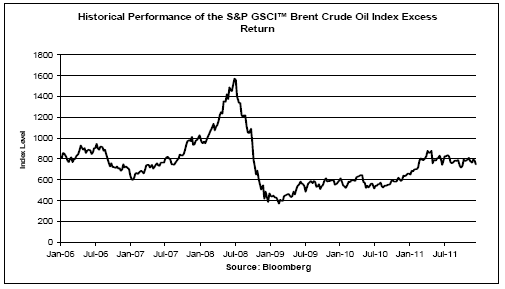
The following graph sets forth the historical
performance of the Index based on the weekly historical Index Closing Levels from January 6, 2006 through December 16, 2011. The
Index Closing Lievel on December 20, 2011 was 770.8731.
We obtained the Index Closing Levels below
from Bloomberg Financial Markets. We make no representation or warranty as to the accuracy or completeness of the information obtained
from Bloomberg Financial Markets. The historical levels of the Index should not be taken as an indication of future performance,
and no assurance can be given as to the Index Closing Level on any of the Accrual Determination Dates. We cannot give you assurance
that the performance of the Index will result in any positive interest payments.
JPMorgan Structured Investments —
|
TS-8 |
| Range
Accrual Notes linked to the S&P GSCI™ Brent Crude Oil Index Excess Return |
