
|
Term Sheet
|
Term Sheet No. 1 to
Product Supplement No. 60-II Registration Statement No. 333-130051 Dated February 27, 2008; Rule 433 |
 |
|
Structured |
JPMorgan
Chase & Co. |
||
General
-
The notes are designed for investors who seek an uncapped return that will not be less than 1.30 or greater than 1.35 times the appreciation of a weighted basket of two commodity indices at maturity. Investors should be willing to forgo interest payments and, if the Basket declines by more than 20%, be willing to lose up to 80% of their principal.
-
Senior unsecured obligations of JPMorgan Chase & Co. maturing September 17, 2012†.
-
Minimum denominations of $1,000 and integral multiples thereof.
-
The notes are expected to price on or about March 12, 2008 and are expected to settle on or about March 17, 2008.
Key Terms
|
Basket: |
The notes are linked to a basket consisting of the Dow Jones — AIG Commodity IndexSM (“DJAIG Index”) and the S&P GSCITM Precious Metals Index Excess Return (“S&P GSCITM Precious Metals Index”, Bloomberg symbol “SPGCPMP”) (each a “Basket Component,” and together, the “Basket Components”). |
|
|
Component Weightings: |
The DJAIG Index Weighting (“AIG Commodity Weighting”) is 75% and the S&P GSCITM Precious Metals Index Weighting (the “Precious Metals Weighting”) is 25% (each a “Component Weighting,” and collectively, the “Component Weightings”). |
|
|
Upside Leverage Factor: |
The Upside Leverage Factor will be determined on the pricing date and will not be less than 1.30 or greater than 1.35. |
|
|
Payment at Maturity: |
If the Ending Basket Level is greater than the Starting Basket Level, you will receive a cash payment that provides you with a return per $1,000 principal amount note equal to the Basket Return multiplied by the Upside Leverage Factor. Accordingly, if the Basket Return is positive, your payment per $1,000 principal amount note will be calculated as follows: |
|
|
|
$1,000 + [$1,000 x (Basket Return x Upside Leverage Factor)] |
|
|
|
Your principal is protected against up to a 20% decline in the Basket. If the Ending Basket Level declines from the Starting Basket Level by up to 20%, you will receive the principal amount of your notes at maturity. If the Ending Basket Level declines from the Starting Basket Level by more than 20%, you will lose 1% of the principal amount of your notes for every 1% that the Basket declines beyond 20%. Under these circumstances, your final payment per $1,000 principal amount note will be calculated as follows: |
|
|
|
$1,000 + [$1,000 x (Basket Return + 20%)] |
|
|
|
If the Ending Basket Level declines from the Starting Basket Level by more than 20%, you could lose up to $800 per $1,000 principal amount note. |
|
|
Buffer Amount: |
20%, which results in a minimum payment of $200 per $1,000 principal amount note. |
|
|
Basket Return: |
Ending Basket Level –
Starting Basket Level |
|
|
Starting Basket Level: |
Set equal to 100 on the pricing date. |
|
|
Ending Basket Level: |
The Basket Closing Level on the Observation Date. |
|
|
Basket Closing Level: |
The Basket Closing Level on any trading day will be calculated as follows: |
|
|
|
100 x [1 + (AIG Commodity Return * AIG Commodity Weighting) + (Precious Metals Return * Precious Metals Weighting)] |
|
|
|
Each of the AIG Commodity Return and Precious Metals Return reflects the performance of the respective Basket Component, expressed as a percentage, from its respective closing level on the pricing date to its respective closing level on such trading day. For additional information, see “Description of Notes — Payment at Maturity” in the accompanying product supplement no. 60-II. |
|
|
Observation Date†: |
September 12, 2012 |
|
|
Maturity Date†: |
September 17, 2012 |
|
|
CUSIP: |
48123MWT5 |
|
|
† |
Subject to postponement in the event of a market disruption event and as described under “Description of Notes — Payment at Maturity” in the accompanying product supplement no. 60-II. |
Investing in the Buffered Return Enhanced Notes involves a number of risks. See “Risk Factors” beginning on page PS-15 of the accompanying product supplement no. 60-II and “Selected Risk Considerations” beginning on page TS-2 of this term sheet.
JPMorgan Chase & Co. has filed a registration statement (including a prospectus) with the Securities and Exchange Commission, or SEC, for the offering to which this term sheet relates. Before you invest, you should read the prospectus in that registration statement and the other documents relating to this offering that JPMorgan Chase & Co. has filed with the SEC for more complete information about JPMorgan Chase & Co. and this offering. You may get these documents without cost by visiting EDGAR on the SEC website at www.sec.gov. Alternatively, JPMorgan Chase & Co., any agent or any dealer participating in this offering will arrange to send you the prospectus, each prospectus supplement, product supplement no. 60-II and this term sheet if you so request by calling toll-free 866-535-9248.
You may revoke your offer to purchase the notes at any time prior to the time at which we accept such offer by notifying the applicable agent. We reserve the right to change the terms of, or reject any offer to purchase the notes prior to their issuance. In the event of any changes to the terms of the notes, we will notify you and you will be asked to accept such changes in connection with your purchase. You may also choose to reject such changes in which case we may reject your offer to purchase.
Neither the Securities and Exchange Commission nor any state securities commission has approved or disapproved of the notes or passed upon the accuracy or the adequacy of this term sheet or the accompanying prospectus supplements and prospectus. Any representation to the contrary is a criminal offense.
|
|
|||
|
|
Price to Public |
Fees and Commissions (1) |
Proceeds to Us |
|
|
|||
|
Per note |
$ |
$ |
$ |
|
|
|||
|
Total |
$ |
$ |
$ |
|
|
|||
| (1) |
If the notes priced today and assuming an Upside Leverage Factor of 1.30, J.P. Morgan Securities Inc., which we refer to as JPMSI, acting as agent for JPMorgan Chase & Co., would receive a commission of approximately $48.00 per $1,000 principal amount note and would use a portion of that commission to allow concessions to other dealers of approximately $25.00 per $1,000 principal amount note. The actual commission received by JPMSI may be more or less than $48.00 and will depend on market conditions on the pricing date. In no event will the commission received by JPMSI exceed $55.00 per $1,000 principal amount note. See “Underwriting” beginning on page PS-122 of the accompanying product supplement no. 60-II. |
|
The notes are not bank deposits and are not insured by the Federal Deposit Insurance Corporation or any other governmental agency, nor are they obligations of, or guaranteed by, a bank.
JPMorgan
February 27, 2008
ADDITIONAL TERMS SPECIFIC TO THE NOTES
You should read this term sheet together with the prospectus dated December 1, 2005, as supplemented by the prospectus supplement dated October 12, 2006 relating to our Series E medium-term notes of which these notes are a part, and the more detailed information contained in product supplement no. 60-II dated February 27, 2008. This term sheet, together with the documents listed below, contains the terms of the notes and supersedes all other prior or contemporaneous oral statements as well as any other written materials including preliminary or indicative pricing terms, correspondence, trade ideas, structures for implementation, sample structures, fact sheets, brochures or other educational materials of ours. You should carefully consider, among other things, the matters set forth in “Risk Factors” in the accompanying product supplement no. 60-II, as the notes involve risks not associated with conventional debt securities. We urge you to consult your investment, legal, tax, accounting and other advisers before you invest in the notes.
You may access these documents on the SEC website at www.sec.gov as follows (or if such address has changed, by reviewing our filings for the relevant date on the SEC website):
-
Product supplement no. 60-II dated February 27, 2008:
http://www.sec.gov/Archives/edgar/data/19617/000089109208001254/e30557_424b2.htm
-
Prospectus supplement dated October 12, 2006:
http://www.sec.gov/Archives/edgar/data/19617/000089109206003117/e25276_424b2.pdf
-
Prospectus dated December 1, 2005:
http://www.sec.gov/Archives/edgar/data/19617/000089109205002389/e22923_base.txt
Our Central Index Key, or CIK, on the SEC website is 19617. As used in this term sheet, the “Company,” “we,” “us” or “our” refers to JPMorgan Chase & Co.
Selected Purchase Considerations
-
UNCAPPED APPRECIATION POTENTIAL — The notes provide the opportunity to enhance returns by multiplying a positive Basket Return by the Upside Leverage Factor. The actual Upside Leverage Factor will be set on the pricing date and will not be less than 1.30 or greater than 1.35. The notes are not subject to a predetermined maximum gain and, accordingly, any return at maturity will be determined by the appreciation of the Basket. Because the notes are our senior unsecured obligations, payment of any amount at maturity is subject to our ability to pay our obligations as they become due.
-
LIMITED PROTECTION AGAINST LOSS — Payment at maturity of the principal amount of your notes is protected against a decline in the Ending Basket Level, as compared to the Starting Basket Level, of up to 20%. If the Ending Basket Level declines by more than 20%, for every 1% decline beyond 20%, you will lose an amount equal to 1% of the principal amount of your notes. Accordingly, at maturity you will receive a payment equal to at least $200 for each $1,000 principal amount note.
-
DIVERSIFICATION AMONG THE BASKET COMPONENTS — Because the DJAIG Index makes up 75% of the Basket, we expect that generally the market value of your notes and your payment at maturity will depend significantly on the performance of the DJAIG Index.
The return on the notes is linked to a basket consisting of the Dow Jones — AIG Commodity IndexSM and the S&P GSCITM Precious Metals Index. The Dow Jones — AIG Commodity IndexSM, which we refer to as the DJAIG Index, is composed of exchange-traded futures contracts on physical commodities and is designed to be a highly liquid and diversified benchmark for commodities as an asset class. Its component weightings are determined primarily based on liquidity data, which is the relative amount of trading activity of a particular commodity. S&P GSCITM Precious Metals Index Excess Return, which we refer to as the S&P GSCITM Precious Metals Index, is a sub-index of the S&P GSCITM, a composite index of commodity sector returns, calculated, maintained and published daily by Standard & Poor’s, a division of The McGraw-Hill Companies (“S&P”). The S&P GSCITM is a world production-weighted index that is designed to reflect the relative significance of principal non-financial commodities (i.e., physical commodities) in the world economy. The S&P GSCITM represents the return of a portfolio of the futures contracts for the underlying commodities. The S&P GSCITM Precious Metals Index Excess Return represents the precious metals commodity components of the S&P GSCITM, including Gold and Silver. For additional information about the Basket and each Basket Component, please see “The Dow Jones — AIG Commodity IndexSM ” and “The GSCITM Indices” in the accompanying product supplement no. 60-II. -
CAPITAL GAINS TAX TREATMENT — You should review carefully the section entitled “Certain U.S. Federal Income Tax Consequences” in the accompanying product supplement no. 60-II. Subject to the limitations described therein, and based on certain factual representations received from us, in the opinion of Sidley Austin LLP, it is reasonable to treat your purchase and ownership of the notes as an “open transaction” for U.S. federal income tax purposes. Assuming this characterization is respected, your gain or loss on the notes should be treated as long-term capital gain or loss if you hold the notes for more than a year, whether or not you are an initial purchaser of notes at the issue price. However, the Internal Revenue Service (the “IRS”) or a court may not respect this characterization or treatment of the notes, in which case the timing and character of any income or loss on the notes could be significantly and adversely affected. In addition, the notes could be treated as “contingent payment debt instruments,” as discussed in the section entitled “Certain U.S. Federal Income Tax Consequences” in the accompanying product supplement no. 60-II. Moreover, on December 7, 2007, Treasury and the IRS released a notice requesting comments on a number of possible U.S. federal income tax treatments for “prepaid forward contracts” and similar instruments. The notice focuses in particular on whether to require holders of instruments such as the notes to accrue income over the term of their investment. It also asks for comments on a number of related topics, including the character of income or loss with respect to these investments; the degree, if any, to which any income (including any mandated accruals) recognized by Non-U.S. Holders should be subject to withholding tax; and whether these investments are or should be treated as “constructive ownership transactions.” While the notice requests comments on appropriate transition rules and effective dates, any Treasury regulations or other guidance issued after consideration of these issues could materially and adversely affect the tax consequences of ownership and disposition of the notes, possibly on a retroactive basis. You should consult your tax adviser regarding the tax treatment of the notes, including possible alternative characterizations in general and the possible impact of the notice described above in particular.
|
|
|
|
JPMorgan
Structured Investments —
Buffered Return Enhanced Notes Linked to a Weighted Basket Consisting of the Dow Jones - AIG Commodity IndexSM and the S&P GSCITM Precious Metals Index Excess Return due September 17, 2012 |
TS-1 |
Selected Risk Considerations
An investment in the notes involves significant risks. Investing in the notes is not equivalent to investing directly in the Basket, the Basket Components or the exchange-traded futures contracts included in the Basket Components. These risks are explained in more detail in the “Risk Factors” section of the accompanying product supplement no. 60-II dated February 27, 2008.
- YOUR INVESTMENT IN THE NOTES MAY RESULT IN A LOSS — The notes do not guarantee any return of principal in excess of $200 per $1,000 principal amount note. The return on the notes at maturity is linked to the performance of the Basket and will depend on whether, and the extent to which, the Basket Return is positive or negative. Your investment will be exposed to any decline in the Ending Basket Level, as compared to the Starting Basket Level, beyond the 20% buffer. Accordingly, you could lose up to $800 for each $1,000 principal amount note that you invest in.
- CHANGES IN THE VALUE OF THE BASKET COMPONENTS MAY OFFSET EACH OTHER — Price movements in the Basket Components may not correlate with each other. At a time when the value of one of the Basket Components increases, the value of the other Basket Component may not increase as much or may even decline in value. Therefore, in calculating the Ending Basket Level, increases in the value of one of the Basket Components may be moderated, or more than offset, by lesser increases or declines in the level of the other Basket Component, particularly if the Basket Component that appreciates is of relatively low weight in the Basket. There can be no assurance that the Ending Basket Level will be greater than the Starting Basket Level. If the Basket Return is negative or zero, you could lose up to $800 for each $1,000 principal amount note that you invest in.
- INVESTMENTS RELATED TO THE VALUE OF THE BASKET COMPONENTS MAY BE MORE VOLATILE THAN TRADITIONAL SECURITIES INVESTMENTS — The value of each Basket Component is subject to variables that may be less significant to the values of traditional securities such as stocks and bonds, and where the return on the securities is not related to commodities or commodities futures contracts. Variables such as changes in supply and demand relationships, governmental programs and policies, national and international political and economic events, changes in interest and exchange rates, trading activities in commodities and related contracts, weather, trade, fiscal, monetary and exchange control policies may have a larger impact on commodity prices and commodity-linked indices than on traditional securities. These additional variables may create additional investment risks that cause the value of the notes to be more volatile than the values of traditional securities and may cause the levels of the Basket Components to move in unpredictable and unanticipated directions and at unpredictable or unanticipated rates.
- NO INTEREST IN THE COMMODITIES UPON WHICH THE FUTURES CONTRACTS THAT COMPOSE THE BASKET COMPONENTS ARE BASED OR CERTAIN OTHER COMMODITY-RELATED CONTRACTS — As a holder of the notes, you will not receive any interest payments, and you will not have any rights that owners of the commodities upon which the futures contracts that compose the Basket Components are based. The return on your notes will not reflect the return you would realize if you actually purchased the commodities upon which the futures contracts that compose the Basket Components are based, or exchange-traded or over-the-counter instruments based on any of the Basket Components.
- HIGHER FUTURE PRICES OF COMMODITIES INCLUDED IN THE BASKET COMPONENTS RELATIVE TO THEIR CURRENT PRICES MAY LEAD TO A DECREASE IN THE PAYMENT AT MATURITY OF THE NOTES — As the contracts that underlie the Basket Components come to expiration, they are replaced by contracts that have a later expiration. For example, a contract purchased and held in August may specify an October expiration. As time passes, the contract expiring in October is replaced by a contract for delivery in November. This is accomplished by selling the October contract and purchasing the November contract. This process is referred to as “rolling.” Excluding other considerations, if the market for these contracts is in “backwardation,” where the prices are lower in the distant delivery months than in the nearer delivery months, the sale of the October contract would take place at a price that is higher than the price of the November contract, thereby creating a “roll yield.” While many of the contracts included in the Basket Components have historically exhibited consistent periods of backwardation, backwardation will most likely not exist at all times. Moreover, some of the commodities reflected in the Basket Components have historically exhibited “contango” markets rather than backwardation. Contango markets are those in which prices are higher in more distant delivery months than in nearer delivery months. Commodities may also fluctuate between backwardation and contango markets. The absence of backwardation in the commodity markets could result in negative “roll yields,” which could adversely affect the value of the Basket and, accordingly, the payment at maturity of the Notes.
- CHANGES IN THE COMPOSITION AND VALUATION OF THE BASKET COMPONENTS MAY ADVERSELY AFFECT THE PAYMENT AT MATURITY AND/OR THE MARKET VALUE OF THE NOTES — The composition of the DJAIG Index, S&P GSCITM and its sub-indices (including the S&P GSCITM Precious Metals Index) may change over time, as additional futures contracts satisfy the eligibility criteria or futures contracts currently included in the Basket Components fail to satisfy such criteria. The weighting factors applied to each commodity included in the Basket Components change annually, based on changes in commodity production statistics. In addition, the index publishers may modify the methodology for determining the composition and weighting of the Basket Components and for calculating their value in order to assure that the Basket Components represent a measure of the performance over time of the markets for the underlying commodities. A number of modifications to the methodology for determining the contracts to be included in the Basket Components, and for valuing Basket Components, have been made in the past several years and further modifications may be made in the future. Such changes could adversely affect the payment at maturity and/or the market value of the Notes.
- S&P GSCITM PRECIOUS METALS INDEX MAY BE MORE VOLATILE AND SUSCEPTIBLE TO PRICE FLUCTUATIONS OF COMMODITIES THAN A BROADER COMMODITIES INDEX — The S&P GSCITM Precious Metals Index may be more volatile and susceptible to price fluctuations than a broader commodities index, such as the S&P GSCITM. In contrast to the S&P GSCITM, which includes contracts on the principal physical commodities that are actively traded, S&P GSCITM Precious Metals Index is comprised of contracts on only a portion of such physical commodities. As a result, price volatility in the contracts included in the S&P GSCITM will likely have a greater impact on S&P GSCITM Precious
|
|
|
|
JPMorgan
Structured Investments —
Buffered Return Enhanced Notes Linked to a Weighted Basket Consisting of the Dow Jones - AIG Commodity IndexSM and the S&P GSCITM Precious Metals Index Excess Return due September 17, 2012 |
TS-2 |
- CERTAIN BUILT-IN COSTS ARE LIKELY TO ADVERSELY AFFECT THE VALUE OF THE NOTES PRIOR TO MATURITY — While the payment at maturity described in this term sheet is based on the full principal amount of your notes, the original issue price of the notes includes the agent’s commission and the cost of hedging our obligations under the notes through one or more of our affiliates. As a result, and as a general matter, the price, if any, at which JPMSI will be willing to purchase notes from you in secondary market transactions, if at all, will likely be lower than the original issue price and any sale prior to the maturity date could result in a substantial loss to you. This secondary market price will also be affected by a number of factors aside from the agent’s commission and hedging costs, including those set forth under “Many Economic and Market Factors Will Impact the Value of the Notes” below.
- LACK OF LIQUIDITY — The notes will not be listed on any securities exchange. JPMSI intends to offer to purchase the notes in the secondary market but is not required to do so. Even if there is a secondary market, it may not provide enough liquidity to allow you to trade or sell the notes easily. Because other dealers are not likely to make a secondary market for the notes, the price at which you may be able to trade your notes is likely to depend on the price, if any, at which JPMSI is willing to buy the notes.
- POTENTIAL CONFLICTS — We and our affiliates play a variety of roles in connection with the issuance of the notes, including acting as calculation agent and hedging our obligations under the notes. In performing these duties, the economic interests of the calculation agent and other affiliates of ours are potentially adverse to your interests as an investor in the notes.
- MANY ECONOMIC AND MARKET FACTORS WILL IMPACT THE VALUE OF THE NOTES — In addition to the level of the Basket on any day, the value of the notes will be affected by a number of economic and market factors that may either offset or magnify each other, including:
- the volatility, frequency and magnitude of changes in the value of the Basket Components;
- supply and demand trends at any time for the physical commodities upon which the futures contracts that compose each of the Basket Components or the exchange traded futures contracts on such commodities;
- the market price of the physical commodities upon which the futures contracts that compose the Basket Components are based or the exchange traded futures contracts on such commodities;
- a variety of economic, financial, political and regulatory, geographical, meteorological or judicial events;
- interest and yield rates in the market generally;
- the time remaining to the maturity of the notes; and
- our creditworthiness, including actual or anticipated downgrades in our credit ratings.
The notes are not designed to be short-term trading instruments. Accordingly, you should be able and willing to hold your notes to maturity.
|
|
|
|
JPMorgan
Structured Investments —
Buffered Return Enhanced Notes Linked to a Weighted Basket Consisting of the Dow Jones - AIG Commodity IndexSM and the S&P GSCITM Precious Metals Index Excess Return due September 17, 2012 |
TS-3 |
What Is the Total Return on the Notes at Maturity Assuming a Range of Performance for the Basket?
The following table illustrates the hypothetical total return at maturity on the notes. The “total return” as used in this term sheet is the number, expressed as a percentage, that results from comparing the payment at maturity per $1,000 principal amount note to $1,000. The hypothetical total returns set forth below assume an Upside Leverage Factor of 1.30. The Upside Leverage Factor will be determined on the pricing date and will not be less than 1.30 or greater than 1.35. The hypothetical total returns set forth below are for illustrative purposes only and may not be the actual total returns applicable to a purchaser of the notes. The numbers appearing in the following table and examples have been rounded for ease of analysis.
|
|
|||||
|
Ending |
Basket Return |
Total Return |
|||
|
|
|||||
|
170.00 |
70.000% |
91.00% |
|||
|
160.00 |
60.000% |
78.00% |
|||
|
150.00 |
50.000% |
65.00% |
|||
|
140.00 |
40.000% |
52.00% |
|||
|
130.00 |
30.000% |
39.00% |
|||
|
120.00 |
20.000% |
26.00% |
|||
|
110.00 |
10.000% |
13.00% |
|||
|
105.00 |
5.000% |
6.50% |
|||
|
100.00 |
0.00% |
0.00% |
|||
|
95.00 |
-5.00% |
0.00% |
|||
|
90.00 |
-10.00% |
0.00% |
|||
|
80.00 |
-20.00% |
0.00% |
|||
|
70.00 |
-30.00% |
-10.00% |
|||
|
60.00 |
-40.00% |
-20.00% |
|||
|
50.00 |
-50.00% |
-30.00% |
|||
|
40.00 |
-60.00% |
-40.00% |
|||
|
30.00 |
-70.00% |
-50.00% |
|||
|
20.00 |
-80.00% |
-60.00% |
|||
|
10.00 |
-90.00% |
-70.00% |
|||
|
0.000 |
-100.00% |
-80.00% |
|||
|
|
|||||
Hypothetical Examples of Amounts Payable at Maturity
The following examples illustrate how the total returns set forth in the table on the previous page are calculated.
Example 1: The level of the
Basket increases from a Starting Basket Level of 100 to an Ending Basket Level
of 105.
Because the Ending Basket Level of
105 is greater than the Starting Basket Level of 100, the investor receives a
payment at maturity of $1,065.00 per $1,000 principal amount note, calculated
as follows:
$1,000 + [$1,000 x (5% x 1.30)] = $1,065.00
Example 2: The level of the
Basket decreases from a Starting Basket Level of 100 to an Ending Basket Level
of 80.
Because the Ending Basket Level of
80 is less than the Starting Basket Level of 100 by not more than the Buffer
Amount of 20%, the investor receives a payment at maturity of $1,000 per $1,000
principal amount note.
Example 3: The level of the
Basket decreases from a Starting Basket Level of 100 to an Ending Basket Level
of 70.
Because the Ending Basket Level of
70 is less than the Starting Basket Level of 100 by more than the Buffer Amount
of 20%, the Basket Return is negative and the investor receives a payment at
maturity of $900 per $1,000 principal amount note, calculated as follows:
$1,000 + [$1,000 x (-30% + 20%)] = $900
Example 4: The level of the
Basket decreases from a Starting Basket Level of 100 to an Ending Basket Level
of 0.
Because the Ending Basket Level of 0
is less than the Starting Basket Level of 100 by more than the Buffer Amount of
20%, the Basket Return is negative and the investor receives a payment at
maturity of $200 per $1,000 principal amount note, which reflects the principal
protection provided by the Buffer Amount of 20%, calculated as follows:
$1,000 + [$1,000 x (-100% + 20%)] = $200
|
|
|
|
JPMorgan
Structured Investments —
Buffered Return Enhanced Notes Linked to a Weighted Basket Consisting of the Dow Jones - AIG Commodity IndexSM and the S&P GSCITM Precious Metals Index Excess Return due September 17, 2012 |
TS-4 |
Historical Information
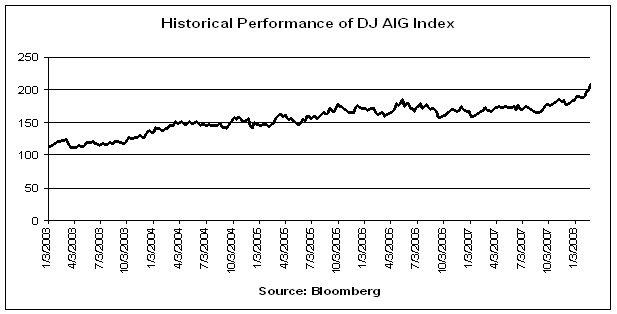
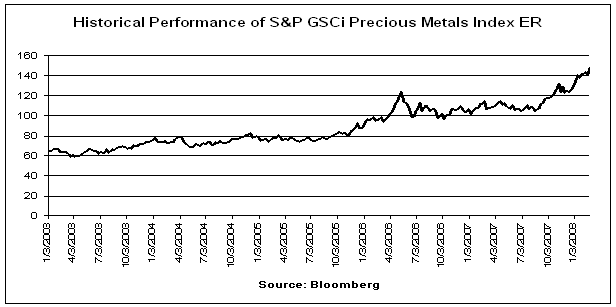
The following graphs show the historical weekly performance the Dow Jones — AIG Commodity IndexSM and the S&P GSCITM Precious Metals Index Excess Return from January 3, 2003 through February 22, 2008. The closing levels of the Dow Jones — AIG Commodity IndexSM and the S&P GSCITM Precious Metals Index Excess Return on February 26, 2008 were 212.562 and 148.5175, respectively.
We obtained the various Basket Component closing levels below from Bloomberg Financial Markets. We make no representation or warranty as to the accuracy or completeness of information obtained from Bloomberg Financial Markets. The historical levels of each Basket Component and of the Basket as a whole should not be taken as an indication of future performance, and no assurance can be given as to the closing level of any Basket Component on any of the Ending Averaging Dates. We cannot give you assurance that the performance of the Basket Components will result in the return of any of your initial investment in excess of $200 per $1,000 principal amount note.
|
|
|
|
JPMorgan
Structured Investments —
Buffered Return Enhanced Notes Linked to a Weighted Basket Consisting of the Dow Jones - AIG Commodity IndexSM and the S&P GSCITM Precious Metals Index Excess Return due September 17, 2012 |
TS-5 |